200+ Experiments, 11 Markets, 20%+ Uplift in Every One
As CRO Manager at audibene in Berlin, I drove more than 200 behavioral-science-led A/B tests across 11 international markets, delivered 20%+ cumulative conversion uplift in every market I worked on, and owned CRO for the Asian markets.
- Milestone: Drove 200+ A/B tests across ad and landing-page journeys
- Milestone: Worked across 11 international markets, owning CRO for Asia
- Increased: Conversion rose 20%+ (cumulative) in every market I worked on
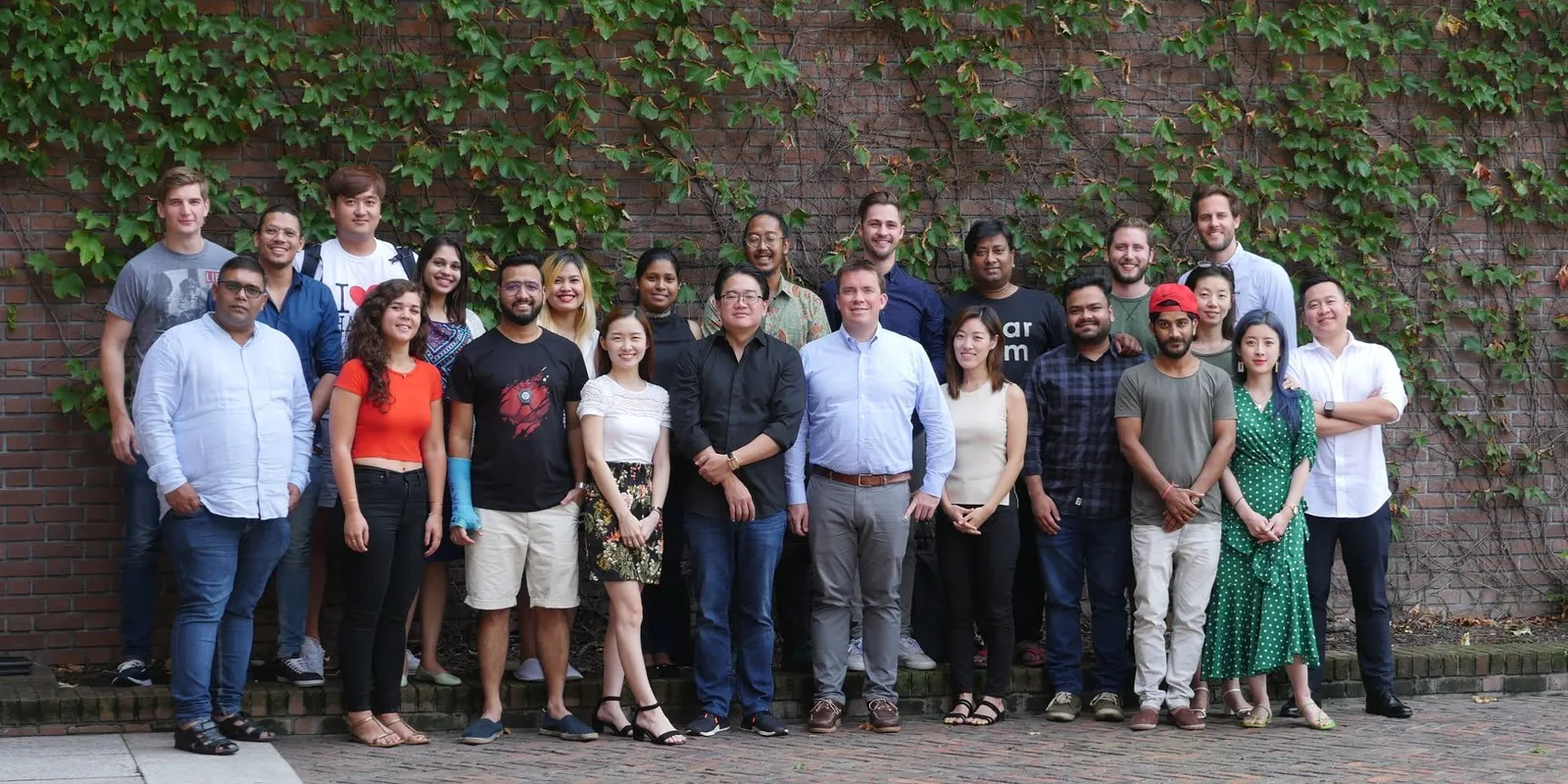
The audibene team · Berlin
The context
audibene helps people with hearing loss find the right hearing aid. The journey usually starts with an ad and a short online questionnaire, and ends with a consultation. It is a sensitive decision: many customers have postponed it for years.
I joined the central CRO team at headquarters in Berlin as an intern in 2019, became full-time six months later, and grew into the CRO Manager role, working across 11 international markets and owning CRO for the Asian markets: India, South Korea and Malaysia.
The approach: start from what does not change
Jeff Bezos once said that people keep asking him what will change in the next ten years, and almost nobody asks what will stay the same. No customer will ever want Amazon to deliver slower or charge more.
CRO works the same way. Layouts, channels and tools change every year. How people decide does not: they avoid effort, they need to feel safe, and they hesitate when the next step is unclear. So I did not start from the page. I started from the customer journey, found the exact step where people dropped off, and asked why.
The lenses I worked with
Over three years I drove more than 200 A/B tests. Behind them was a small, consistent toolkit:
- Don’t Make Me Think. Every extra decision costs attention. Remove it, or make it obvious.
- Design thinking. Start from the customer’s problem and context, prototype fast, learn from real behavior.
- Thinking, Fast and Slow. Most choices are made on autopilot. Design for the fast brain, reassure the slow one.
- The 7 layers of conversion. A structured way to check, layer by layer, what stands between a visitor and the next step.
- The 5 stages of awareness. Speak to where the customer is: unaware of the problem, or already comparing solutions.
- Behavioral psychology effects. Commitment, social proof, effort perception, loss aversion, and others, used as testable hypotheses rather than tricks.
These lenses turned “this page underperforms” into precise hypotheses about credibility, commitment, effort and local relevance. I tested them in ad and landing-page journeys, working with front-end, analytics, MarTech, design and copy.
What it looked like in practice
- A deliberate pause. Everyone knows faster is better. I tested a 1.5-second pause in the questionnaire, as if the system were working on the customer’s answers. It won in all 11 markets and became the standard. Read the story.
- Easy questions first. We reordered the questionnaire so that each answer felt a little easier than expected. Small yeses built commitment before the harder questions. Read the story.
- Local, not copy-paste. A winner in Germany was a hypothesis for Korea or India, not a rollout. Many ideas had to be rebuilt for local customers. Read why.
Working with the Asian markets
Twice a year, audibene ran an Asia Summit in India, South Korea or Malaysia, bringing together the Managing Director, the country heads and other leaders. I represented the HQ CRO team. Real market problems were put on the table and solved together in hackathons, and each country went home to implement.
I also travelled to work with local teams directly, including a two-week assignment in India to train the team there. It taught me that the hardest part of international work is rarely the language. Read the story.
Results
20%+ cumulative conversion uplift in every market I worked on, including the largest ones such as Germany, South Korea and India. In markets with multi-million-euro monthly revenue, that is a significant commercial impact.
Every test was a lesson
I stopped seeing tests as page tweaks. Each one taught me something about how people decide, and I now use those lessons far beyond landing pages: in performance ads, in negotiations, in everyday life.
1. Relevance comes first
In the 7 layers of conversion, relevance is layer one. Coherent content, where each line follows from the last and matches what people came for, is easy for the fast, intuitive brain (System 1) to process. Easy to digest means people read more, and the more they take in, the more they convert.
Beyond the page: the first second of an ad has to match what the viewer is already thinking about. In a negotiation, I open with the other side’s concern, not my agenda.
2. Small yeses before big ones
Reordering the questionnaire so the easy questions came first raised completion. Each small yes made the next step feel natural.
Beyond the page: in a negotiation, I lock in the easy points first. Agreement builds momentum.
3. A pause can build trust
The 1.5-second “thinking” moment won in all 11 markets. People trust a result that feels considered more than one that appears instantly.
Beyond the page: when someone asks me for a price or a decision, a considered pause carries more weight than an instant answer.
4. Personalization is one of the most advanced levers
Showing each person what fits their situation, market and stage of awareness beat any generic “best practice” page.
Beyond the page: in ads, a different message for someone who has never heard of the problem and someone comparing providers. In life, talking to the person in front of me, not to an average.
5. Look and feel like a stranger
Whoever designs or rolls out a test has to unlearn what they know. I trained myself to set my own bias aside and experience each variant as a first-time visitor who knows nothing about it, and only then judge it.
Beyond the page: I watch my own ads on a phone with the sound off, the way people scroll. I reread an important message as the person receiving it before I send it.
The tests changed. The customer did not. Focusing on human behavior and on the exact point where people drop off is what made the results repeatable across very different markets.
Conversion is not a design problem. It is a question about people, and the best way to answer it is to ask them through a test.